
Nobody’s Candidate
Some Montana Democrats call their own Senate nominee a plant. We went looking for evidence and found who paid for most of the campaign to nominate her: a nonprofit with a one-page website and a mailbox in Delaware.
A storm over the Rocky Mountains, Montana, May 2014. Shadowmeld Photography / Wikimedia Commons, CC BY-SA 4.0, cropped
We started out trying to find a plant.
Since the spring, some Democrats in Montana had been saying it about their own nominee for the U.S. Senate. Alani Bankhead, they said, was not what she appeared to be. She had come from nowhere, won the primary while a committee nobody knew spent millions advertising her, and then refused to get out of the way of the candidate Jon Tester and the party’s large donors preferred. A plant is a candidate slipped into a race to help somebody else win it. In the spring the talk was that Bankhead was a plant for the independent in the race. By September it was that she was a plant for the Republicans. Jon Tester, the Democrat who lost Montana’s other Senate seat in 2024, told the Washington Post: “I wish the Democrat who is really a Republican would get out.” On Oct. 12 the chair of the state party, Shannon O’Brien, resigned to endorse the independent, and put the suspicion as a question. “Democrats should ask themselves,” she wrote, “why Republicans so badly wanted her on the ballot.”
We read the filings, the tax returns and every published account we could open, looking for a payment to her, a meeting, a go-between. We found none in any filing or report we could open. The search led somewhere else, to the organization that paid for most of the campaign to nominate her.
The candidate with the $25 ads
In April, Alani Bankhead was one of five Democrats running for an open Senate seat in Montana. She began the month with $10,625 in her campaign’s account. She was 44, a retired Air Force officer who had spent part of her career helping run stings on people who solicited children online. She had moved to Montana in 2021 or 2022 and announced her candidacy on her own coaching podcast. Roughly seven in ten Montana voters, in a poll that spring, could not say who she was.
Her campaign had little to spend. Its report to the Federal Election Commission for the weeks before the primary lists 37 charges marked “Ad,” the largest of them $25.

At the start of May somebody else began advertising for her. People complimented her on her ads, Montana Free Press reported. What ads? she said.
The ads came from a committee called Progressive Vet PAC, which had registered with the FEC on April 27 from a print-and-ship store in Billings. Its treasurer was a former Democratic legislator from Helena named Moffie Funk. “Someone asked me about Moffie Funk. I didn’t know if Moffie was a guy,” Bankhead told the outlet. “When I tell you I’m the most boring candidate on the planet, all I do is campaign and sleep.”
The PAC spent $2.5 million, nearly all of it on advertising for her. Bankhead had raised less than $24,000. On June 2 she won the nomination by almost 12,000 votes, and a reporter from the Daily Montanan found her in the back room of a Helena bar, pacing and, in the reporter’s words, “in a little bit of a shock,” trying to write a statement. “I’m new at this!” she said.
Four weeks later Progressive Vet PAC announced that “a Democrat does not have a viable path to winning the Montana Senate seat” and left the state. It has reported no spending for her since. Neither has anyone else.
So a committee had appeared from nowhere, spent $2.5 million to nominate a Democrat, and then declared that no Democrat could win. Who would do that, and why?
Contours, Inc.
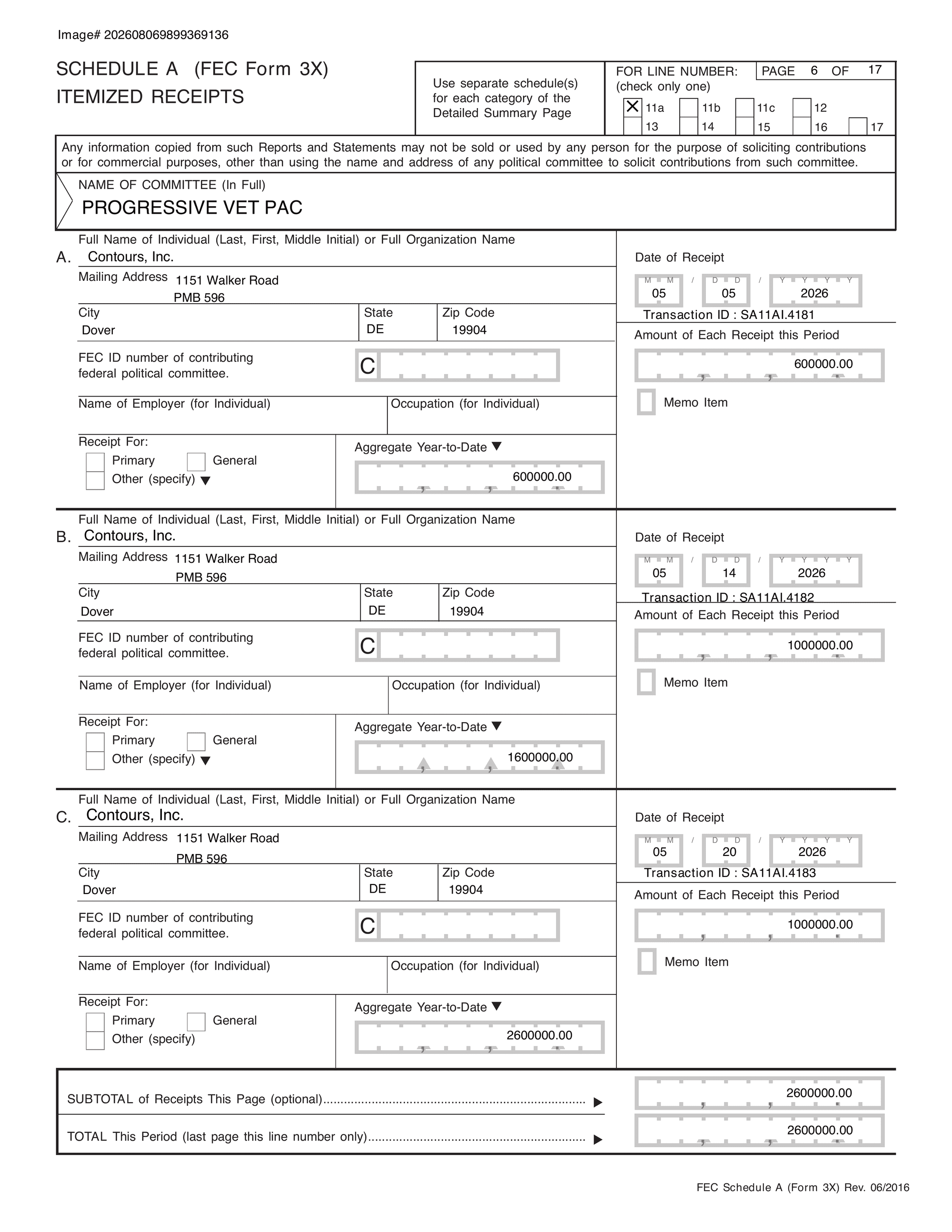
Part of the answer was already on file. On June 20, 18 days after the primary and 10 days before the PAC quit, it had sent the FEC a required report. Before the vote, its only donor on the public record had been a Los Angeles committee that gave it $200,000. The report showed where the rest had come from: three payments in May, $2.6 million in all, from something called Contours, Inc.
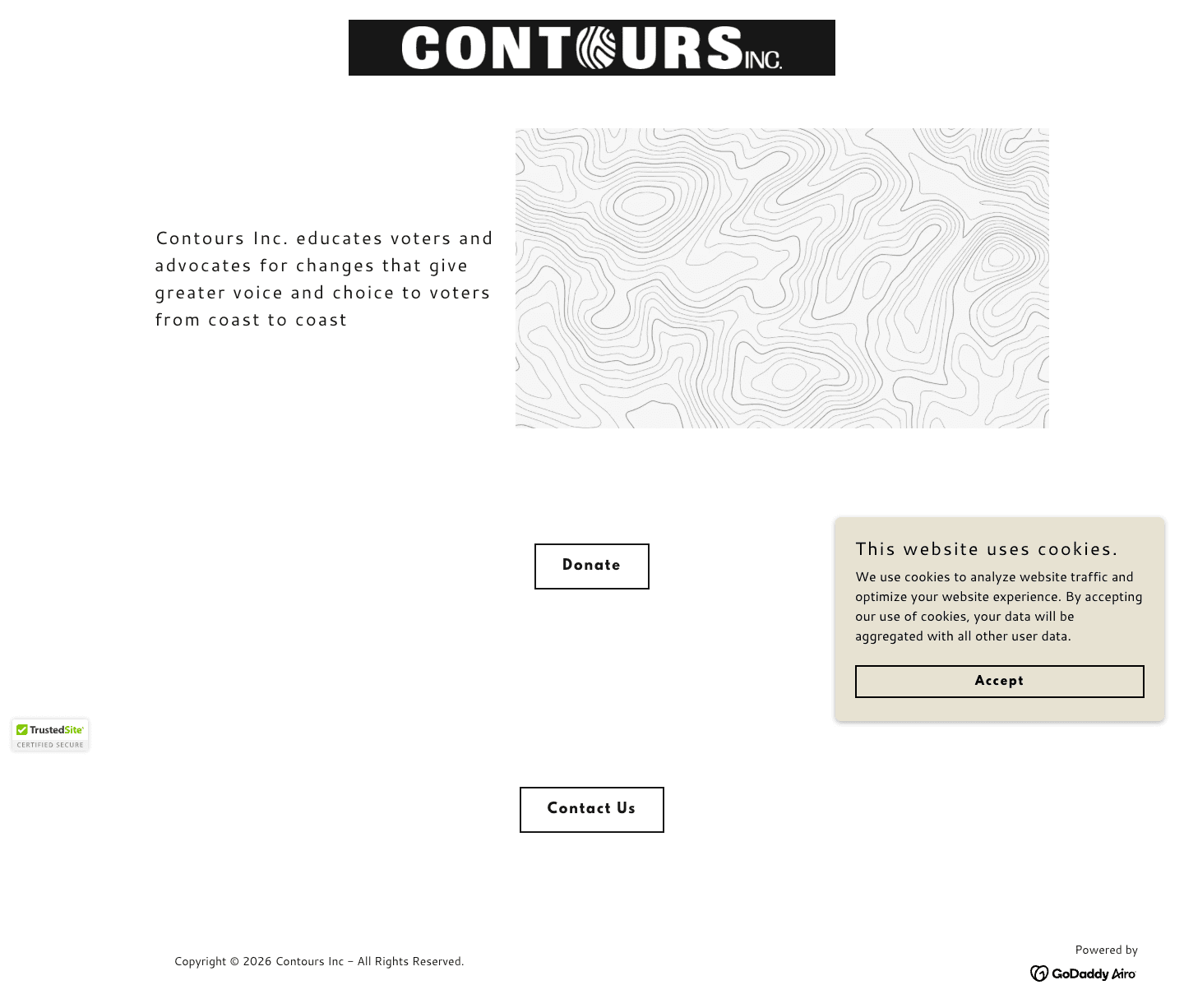
Contours has a website, and the website has one page. It says that Contours Inc. “educates voters and advocates for changes that give greater voice and choice to voters from coast to coast”. Beside the sentence is a stock picture of the wavy lines that mark elevation on a map, and below it are two buttons, “Donate” and “Contact Us.” The page names no officer and gives no address, phone number or email.
The address it gives the people it pays is 1151 Walker Road, No. 596, Dover, Delaware. Five of the nine committees it has paid write that as “PMB 596,” for private mailbox, and the Internal Revenue Service lists 14 other tax-exempt organizations at the same street address. Someone registered its web address on Dec. 20, 2024, and the corporation, by its own account to the IRS, was formed a week later. It is a nonprofit of the kind that never has to name its donors. Its president is a woman named Sarah Stremlau, whom two news outlets, Sludge and Inside Elections, describe as a former executive at Arabella Advisors, a firm that administers large donor funds on the left. No document we found shows Arabella running Contours, and Sludge reported that Stremlau did not answer its questions.

To see how far its money reached, we scanned the electronic filings sent to the FEC from January 2025 to Oct. 10 of this year for its name and address, more than 155,000 of them. Sludge, a news site that follows political money, had already found seven committees that took Contours’ money. We found nine. Two of the nine had spelled the donor’s name wrong, “Countours” in one report and “Contoures” in the other. The total is $8,020,000, in 15 payments, and more than half of it moved in five weeks this spring.
Where Contours’ money came from and where it went
Reported funders
- Global Impact Social Welfare Fund$6.62M, year to June 2025
- A Better Wisconsin Together$1.5M, 2025
- No source on any record we could openabout $5.3M of at least $13.4M paid out
$8.02M in 15 reported payments to nine committees, July 2025 to May 2026
Committees, and what each then did
- Government That Works PAC · $2.9M (2025)About an eighth of its receipts. In July 2026 it reported sending $2.75M to Montana Freedom PAC, which supports Bodnar and paid for the “Bow Out Bankhead” signs.
- Progressive Vet PAC · $2.6M (May 5, 14, 20)All but $200,000 of its money. Spent $2.5M in Montana’s Democratic primary, nearly all to promote Bankhead.
- Independent Candidates Action · $800KPassed money to committees backing independents in Washington and California.
- Common Defense Action Fund · $450K (April 27)Spent $423K in Nebraska’s primaries from April 28, $286K of it for Burbank.
- Working Class Heroes Fund · $450KThe committee Dan Osborn founded.
- Wheel Dog PAC · $300KAlaska House: for the independent, Bill Hill.
- Fire House PAC · $300KWashington’s 5th District: for an independent.
- BDA PAC · $200K · Tennessee Rise PAC · $20KFiled under the misspellings “Countours” and “Contoures.”
What Contours wants
In September 2025 Contours described itself in a letter to the IRS, which a conservative watchdog group later published. The letter listed $25,600 spent so far that year on “political candidate recruitment.” Attached was a draft poll for a congressional district in Nevada. One question read: “In an election between a Republican candidate and an opponent, would you rather vote for a Democrat or an Independent opponent?”
In states and districts where Democrats have stopped winning, some of the party’s former senators and donors have concluded that an independent might do what a Democrat can’t. Contours has given $800,000 to a group called Independent Candidates Action, which exists to elect independents.
During the primary, Independent Candidates Action’s website had this to say about Montana. “Five Democrats have filed, but Montana’s Democratic brand has struggled statewide since Jon Tester’s defeat in 2024,” it read. “As an independent, Bodnar can consolidate voters from across the political spectrum”
Seth Bodnar is the independent in Montana’s Senate race, a former Green Beret who had spent eight years as president of the University of Montana and entered the race with Tester behind him. So the organization paying for Alani Bankhead’s advertising had also funded a group that was, in those same weeks, promoting Seth Bodnar.
Contours also commissioned a poll of Montana from a firm called Tavern Research, taken in the middle of May. The poll did not test Bankhead as the Democratic nominee at all; it tested her better-known rival and a generic Democrat. On May 19 the firm published what it had found. “Every Democrat tested would lose by a wide margin,” its release said, and the best path to beating the Republican was a head-to-head race with Bodnar.
That same day, the PAC that Contours was funding paid the pollster $200,000 for “Research”; the filing does not say what the research was. Also that day it made its first payment for television, $502,569, for commercials urging Montana Democrats to nominate Bankhead.
Nebraska: the playbook
The idea is that an independent can beat a Republican only one-on-one. Put a Democrat on the same ballot and the two of them divide everybody who doesn’t want the Republican, who then wins with less than half the vote. Backing independents is an old idea. The version tried in Nebraska depends on one extra step: the Democratic line on the ballot has to be empty.
In 2024 the state’s Democrats ran nobody for the Senate, and an independent, a union steamfitter named Dan Osborn, lost by 7 points in a state Donald Trump carried by 20. He is running again this year against Sen. Pete Ricketts, another Republican. This time there was a Democratic primary, and one of the two people in it was a retired pharmacy technician named Cindy Burbank. “I will drop out when and if the time comes that I cannot win in November,” she told NBC the week before the vote. “And I think anybody with any dignity should do that.” She denied entering the race in order to quit it, but her campaign website told voters she would back Osborn if she won. Osborn’s campaign has said it had “nothing to do with Cindy Burbank.”
On April 27, the day Progressive Vet PAC registered in Billings, Contours gave $450,000 to a committee in New York called Common Defense Action Fund, which had finished March with $119,000 in the bank. Over the next eight days that committee put out $423,000 of advertising in Nebraska: $286,000 to promote Burbank, $63,000 against her opponent in the Democratic primary, and $73,000 for a candidate in a minor party’s primary, who later quit and endorsed Osborn.
Burbank won with 89.5% of the vote on May 12. In July she withdrew. The state party voted not to replace her, and a poll taken through early October has Osborn and Ricketts tied. Nebraska’s voters were not told who had paid for her advertising, either. Contours first appears in a report the New York committee filed two months after the primary. A Nebraska outlet, Flatwater Free Press, made the connection in August.
That is how it went in Nebraska. A Democrat who had said she would drop out if she could not win was advertised for with Contours’ money, won the nomination and withdrew, and her party left its line on the ballot empty.

Why her
Montana did not have a Burbank. It had two women who had both said, in public, that they were staying.
Reilly Neill was the front-runner. She had been campaigning since 2024, she had a staffed campaign, and she was the only Democrat in the field with more than $100,000 to spend. She had sworn to stay in the race against Bodnar if she won the nomination. Bankhead had sworn the same thing. The Atlantic reported as much about both of them on April 21, six days before the PAC registered.
Everyone with money in the race seems to have decided that only one of them meant it.
Republicans, by the account of reporters covering the race, wanted the Democrat who would stay, because a split vote helps their candidate, and they took that to be Neill. A committee tied to the Republican nominee’s own fundraising spent $1 million on advertising that attacked Neill as “too liberal for Montana.” The Downballot, a newsletter that covers elections, had described the message early on as “a message masquerading as an attack that’s actually designed to make primary voters warm to her.” The same committee spent $900,000 on ads it labeled as support for Bankhead, which praised her to Democrats as someone who “will work with Trump to secure the border.” Its captions spelled her name “Eloni.” A reporter for Lee Newspapers called that “a little reverse psychology” on Montana Public Radio: “Republicans want Reilly Neill to make it through this primary because they believe she’d effectively neutralize Seth Bodnar.”
By the same accounts, the Democratic money wanted the opposite, a nominee who would leave. “Republicans suspect Bankhead will essentially cede the race to Bodnar (despite her denials),” Semafor reported the day before the primary. “Meanwhile, Democrats see Neill as more likely to split the vote.” Progressive Vet PAC’s own advertising told Democrats to “Vote no on Reilly Neill.” The newsletter Inside Elections later wrote that the effort “was primarily to block” Neill, and, without saying how it knew, that the group behind it “believed Bankhead was more likely to drop out of a general election than her primary opponents.”
Nobody who paid has said that was the reason. Funk, the PAC’s treasurer, wrote in May that the effort was important to “those of us who both think she is the best candidate and who oppose the flagrant attempt by Republicans to meddle in the Democratic primary.” We found no comment from Contours in any report we could read.
But if the bet was that a first-time candidate with no money could be eased out after she won, the person it was placed on had already said no. On May 14 Montana Free Press printed her answer to the idea of ceding the race to Bodnar: “Not only no, but hell no.” She asked the reporter to keep the “hell.” Contours sent the PAC $1 million that same day and another $1 million six days later. Three-quarters of the PAC’s spending, and all of its television, came after she had said it.
So $2.5 million was spent urging Democrats to nominate a candidate, with money from an organization whose own poll said every Democrat it tested would lose, which had funded a group promoting her rival, and the committee it funded gave up on her four weeks after the vote. Montana Democrats did not learn who had paid until 18 days after they voted. By Bankhead’s account, nobody told her either.
“They knew Riley wasn’t going to drop out, and so they hedged their bets on me, but I’m not going to drop out,” Bankhead told The Bulwark two weeks after the primary. A Democratic official in Montana, whom The Bulwark did not name, told it: “somebody decided she was going to win the election. And that somebody created a monster.”
Before publication we asked Contours and its president, Sarah Stremlau, to answer these questions, along with the committees it funded and the Bankhead and Bodnar campaigns. Bankhead’s campaign answered on the record. Its operations director, Kaight Meyers, wrote that neither Bankhead “nor anyone on or near her campaign has had any contact with Progressive Vet PAC, Contours or anyone acting for them, at any time,” and that Bankhead learned who the donor was “when everyone else did, from that June 20 filing.” Jose Vasquez, the executive director of Common Defense Action Fund, wrote on Oct. 13 that a colleague would send the group’s response; none had arrived by publication. Bodnar’s campaign sent an automatic acknowledgment and nothing more. Contours, Progressive Vet PAC, Montana Freedom PAC, Government That Works PAC and Tavern Research did not respond.
Idaho and South Dakota
Four Senate races this year had an independent backed by Democrats or their donors: Nebraska, Montana, Idaho and South Dakota. Nebraska and Montana are the two where we found Contours’ money inside the Democratic primary. In Idaho and South Dakota the same idea was being pressed on the Democratic nominees that summer by members of their own party, and no federal filing we scanned shows Contours’ money, or spending by a committee it funded, in either race. Those two nominees had not offered to step aside, and by the first week of August both had given up.
In Idaho, David Roth won his party’s Senate primary in May with an independent already in the race. A former congressman wrote that there was “not a snowball’s chance in hell” Roth would do better than in his earlier campaigns. His party’s committee in Ada County gave him five weeks to raise $50,000 or see it consider endorsing the independent. He announced in July that he was quitting, later wrote “lack of support from Democratic Party” on his withdrawal form, the Idaho Capital Sun reported, and called it “probably the worst experience I’ve ever been through in my entire life.”
In South Dakota, Julian Beaudion was the Democrats’ unopposed nominee. In late July his house caught fire. He has written that on a video call the next day the independent in the race, Brian Bengs, began, as Beaudion recalls it, “I’m not dropping out of this race, and if you stay in, things will get worse for you,” and that on his last morning as a candidate senior political figures and advisers phoned to say that support for him would be withdrawn, publicly, if he stayed. He withdrew on Aug. 4, citing his family’s safety. Beaudion does not say that anyone set the fire. “I am not accusing anyone of setting our house on fire,” he wrote, and the cause was reported in August to be under investigation. What he says is that it was used against him. “It’s one thing to experience a fire when you’re not in politics, but then folks try to use that as leverage,” he told South Dakota Public Broadcasting. Bengs had denied any threat on the day Beaudion withdrew. “Nobody has been attacked or threatened,” he said in a written statement to South Dakota Searchlight.
So in three states the Democratic line on the Senate ballot is empty, by local news reports, which is what the strategy calls for. Nebraska’s nominee had told voters beforehand what she might do. Roth and Beaudion had said for weeks that they were staying.
Townsend, Montana
The night after Beaudion withdrew, Bankhead was in Townsend, Montana, in an old Masonic Lodge, with wildfire smoke hanging over the town and 50 to 70 people in the room, by the counts of two reporters who were there. She spoke and then took questions, and every question was the same question. One voter asked whether she would “continue to show your strength as a leader by withdrawing from the race” so that everyone else could unite against the Republican.
“Thank you for coming, Cara,” Bankhead said. “I really appreciate the question. I’m not going to drop out.”
On a table was a stack of letters from 250 Montana voters asking her to quit, supplied by a political committee that supports Bodnar. The next morning there were yard signs in a flowerbed in Helena, where she lives. “Bow Out Bankhead,” they said.
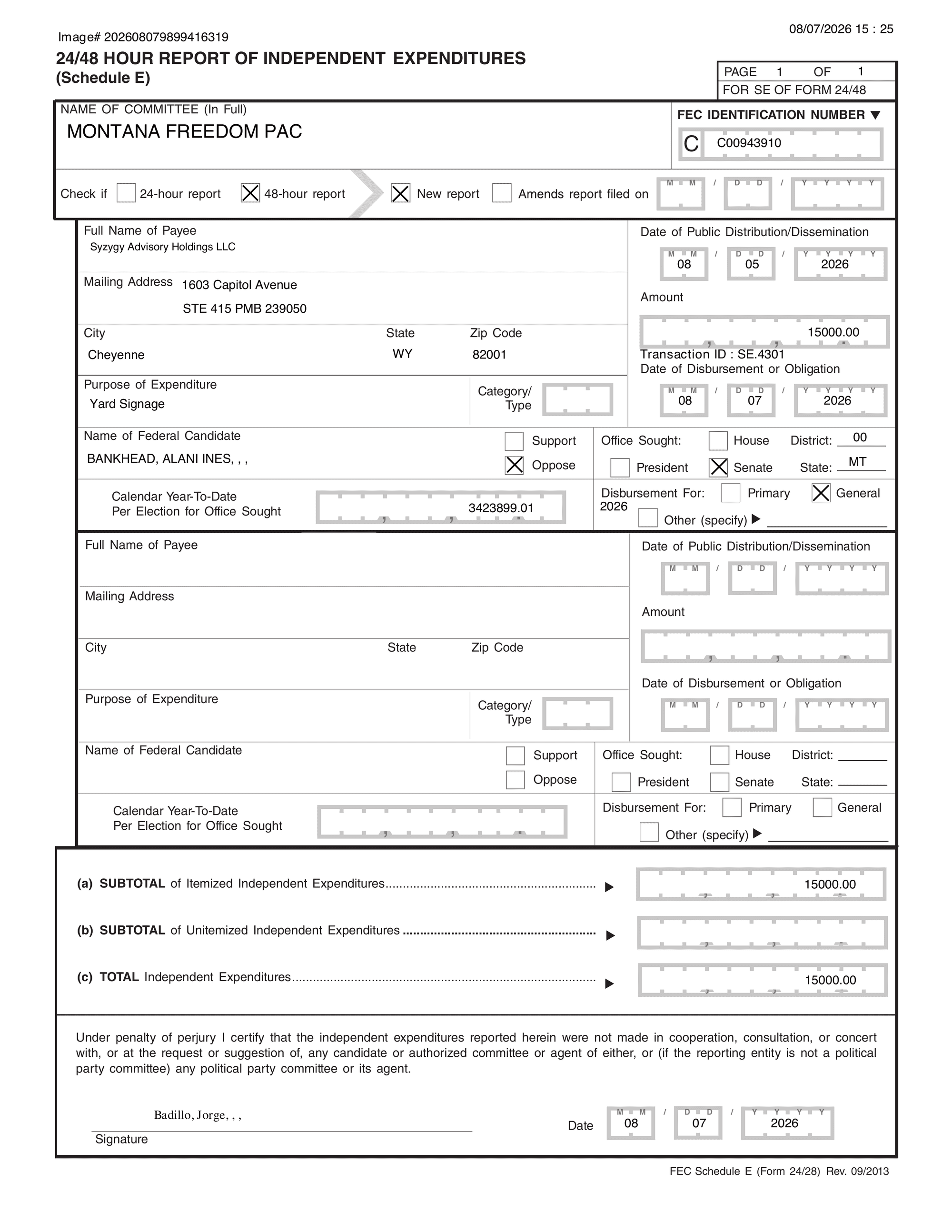
A committee called Montana Freedom PAC, which supports Bodnar, reported paying $15,000 for them. It has reported spending $338,000 against Bankhead in all. And here the trail runs back to Dover. In 2025 Contours gave $2.9 million to a Washington committee called Government That Works PAC, about an eighth of the $23.4 million that committee has reported taking in. In July that committee sent Montana Freedom PAC $2.75 million. So the organization whose money advertised Bankhead to Democrats in May is also a donor to the committee that has supplied more than half of the money on record for the group now paying to push her out. Money in a committee’s account can’t be followed dollar for dollar, so no filing can show that Contours’ money bought a yard sign. Bodnar has said he never asked anyone to drop out, and that it isn’t true his backers put Bankhead through the primary.
Twenty-two Democratic legislators signed a letter asking her to withdraw. The national Democrats’ Senate committee told Semafor that it “partners with viable campaigns who have a path to victory, which Ms. Bankhead does not.” In an essay for the Washington Post she has written that a sitting senator offered her a job and a sitting governor phoned to ask her to step aside; she named neither, and we found no confirmation. (In August she said that “nobody has ever asked me to drop out,” apart from emails from individuals, the Flathead Beacon reported. Her campaign says she meant that nobody had made an official request, and that the asks came through people who presented themselves as friends and advisers.)
Over the summer the plant theory reversed. In the spring the suspicion among Democrats had been that the unexplained money meant she was there for Bodnar, to win and then quit. She didn’t quit, and by September she was being called a plant for the Republicans.
Who called whom a fake
| Accuser | Accused | The words | Reported by |
|---|---|---|---|
| Nebraska Democratic Party | William Forbes | “the fake Democrat plant.” He denied it. | New York Post, May 12 |
| William Forbes | Cindy Burbank | she is the fake Democrat | New York Post, May 12 |
| Nebraska Republican Party | Cindy Burbank | “a proxy for Osborn” | Nebraska Examiner, March 17 |
| A former marijuana-party chair | his own party’s candidate | “Dan Osborn plant.” He has said he is not one. | Nebraska Examiner, March |
| Pete Ricketts’ campaign | Dan Osborn | says he would “plant fake candidates to trick voters” | Nebraska Examiner, Aug. 24 |
| Montana Libertarian Party | its own Senate nominee | “phony candidate.” He says he is not a Republican in disguise. | Daily Montanan, June 11 |
| National Republican Senatorial Committee | Seth Bodnar | “Fake Independent” | release, June 18 |
| An unnamed Republican operative | Bodnar | “almost like he is our plant in the race” | Washington Reporter, July 29 |
| Reilly Neill | Alani Bankhead | “I’m not the shill here” | NonStop Local, June 3–4 |
| An anonymous Substack | Bankhead | “isn’t really a Democrat” | July |
| Bodnar’s spokesperson | Bankhead | asks “why Republican-aligned dark money groups are boosting her campaign” | KTVH, Aug. 10 |
| Jon Tester | Bankhead | “the Democrat who is really a Republican” | Washington Post, Oct. 10 |
| A voter in Whitefish | Bankhead | “I feel she’s a plant” | Washington Post, Oct. 10 |
| Bankhead | Bodnar and Alme | “handpicked by the Establishment” | op-ed, Aug. 6 |
“Plant” is a word these races throw around. In Nebraska, the Democratic Party called Burbank’s primary opponent “the fake Democrat plant”; he denied it and said she was the fake. Burbank had made the same charge against him: she named her campaign website “NOT a Pete Ricketts plant” and wrote on it that Ricketts “is putting in a candidate loyal to him in the Democratic primary to split the vote against him, so he wins easily.” Ricketts’ campaign has denied any involvement with him. Nebraska Republicans, for their part, called Burbank “a proxy for Osborn.” In Montana, the Libertarian Party called its own Senate nominee a “phony candidate”; he says he is not a Republican in disguise. A Republican operative told a conservative outlet that Bodnar was “almost like he is our plant in the race.” Bankhead says her favorite theory about herself is that she was recruited from West Point in 1992, when she was 10 and had never set foot in Montana, to be a plant in this race, because Bodnar went to West Point a few years later. She did not say whose theory it was.
On Aug. 10, the last day she could have taken her name off the ballot, she stood in a park in East Helena and said the powerful were spending a fortune to push her out. “But I will never bow down.”
The record, in order
- April 21The Atlantic reports that Bankhead and Reilly Neill have both sworn to run hard against the independent, Seth Bodnar, if nominated.
- April 27Progressive Vet PAC registers in Billings. The same day, Contours gives $450,000 to a committee that begins advertising in Nebraska’s primaries the next day.
- May 1Progressive Vet PAC’s first advertising for Bankhead.
- May 5Contours sends Progressive Vet PAC $600,000.
- May 12Nebraska: Cindy Burbank wins the Democratic primary with 89.5%.
- May 14“Not only no, but hell no” is published. Contours sends Progressive Vet PAC $1 million.
- May 19Contours’ poll is released: “Every Democrat tested would lose by a wide margin.” Progressive Vet PAC pays the pollster $200,000 and makes its first payment for television.
- May 20Contours sends Progressive Vet PAC another $1 million.
- June 2Bankhead wins the Democratic primary.
- June 20Progressive Vet PAC’s report names Contours as its donor.
- June 30Progressive Vet PAC says a Democrat has no “viable path” and leaves.
- July 17Nebraska: Burbank withdraws.
- Aug. 5Townsend. The next morning, “Bow Out Bankhead” signs in Helena.
- Aug. 10Last day to leave the ballot. Bankhead stays.
- Oct. 12The chair of the Montana Democratic Party resigns and endorses Bodnar.
The chair’s question
On Oct. 12 the chair of the Montana Democratic Party, Shannon O’Brien, resigned and endorsed Bodnar. In an essay for MS NOW she wrote that “Bankhead does not have the momentum, resources or will to win this race,” and that she “has also benefited from Republican spending designed to split the opposition and clear a path for Alme.” She added: “Democrats should ask themselves why Republicans so badly wanted her on the ballot.”
The record does not support the premise of that question. Reporters who covered the primary read the Republican-tied committee’s advertising as an effort to nominate Reilly Neill: its ads labeled as support for Bankhead praised her to Democratic voters as someone who “will work with Trump,” and a Lee Newspapers reporter said at the time that “Republicans want Reilly Neill to make it through this primary because they believe she’d effectively neutralize Seth Bodnar.” The committee that advertised for Bankhead to win was Progressive Vet PAC, and its money was Contours’. It accounts for about 72% of the $3.2 million that committees reported spending in support of her. O’Brien’s essay mentions neither Progressive Vet PAC nor Contours.
Bankhead answered through a spokesperson: “Shannon didn’t switch sides today. She’s been working against the Democratic nominee since the summer.” The party’s vice chair, Bruce Knutson, has taken over as chair. O’Brien and the party did not respond to requests for comment sent on Oct. 13.
What we found
We went looking for a plant and did not find one. No filing or report we could open shows a payment to Alani Bankhead, a contact with her or an arrangement of any kind. A private understanding would leave no record, so nobody can rule one out. But the first theory predicted that she would quit, and she didn’t.
She says she had nothing to do with the money. “We’ve had no contact with them,” she told the Daily Montanan five days before the primary. A committee of this kind may not by law coordinate its spending with a candidate, and no filing or report we could open shows that it did. Her campaign did not quarrel with what the PAC’s ads said. In a statement the Daily Montanan published four days after the primary, her spokesperson said the PAC “actually reflects the real values of the campaign,” though voters should hear from the candidate and not from PACs. The campaign says the statement was given on May 21, twelve days before the vote, when nobody outside the PAC knew who was funding it. In a press release the campaign posted on May 22, aimed at Alme and the Republican-tied committee, Bankhead said dark money “that comes from lobbyists, corporations, and billionaires should be illegal, regardless as to whether it comes from the left or the right,” and that her campaign “has done everything in its legal power to disavow dark money.” Three days before the primary a voter on Bluesky accused her of sitting by while PACs put out commercials “pushing you.” She replied: “I’ve categorically denounced all dark money and all the ads.” She said before the advertising began that she would stay in the race, and she said it again while it was running. Then she won 48,772 votes and stayed.
“Forty-eight thousand Montanans voted for me using the democratic process as set forth by Montana law,” she texted Montana Free Press in July. “The split vote was created by the independent. Therefore, it’s his problem to fix by dropping out.” Others have defended her staying. “What does it say to them if she leaves?” her state party’s spokesperson said to the Daily Montanan in August, speaking of the people who voted in the primary. “It’s a form of voter suppression.” Brian Schweitzer, a former Democratic governor who backed Neill in the primary, told the Flathead Beacon that “it’s just disingenuous for an independent candidate to point a finger at a Democrat who won a primary and say, ‘well, why don’t you get out of the race.’”
Schweitzer, who now supports Bankhead, thinks the whole idea was a mistake in Montana. “Montana ain’t Nebraska. We simply ain’t Idaho. And we’re not South Dakota,” he told The Bulwark. “The right Democrats can win in Montana.” Of Bodnar he told the Washington Post: “All he had to do was run as a Democrat and he’d be leading this race now 55 [percent] to 45. He was getting advice from people who don’t use calculators, I guess.” Nobody can test that now. What can be said is that the Democrat Montana’s voters nominated never got an ordinary run at the seat. She has spent the summer and fall being asked to quit and being called a plant.
Bodnar says he never asked her to leave, and he put himself on the ballot with more than 21,000 signatures. In a Montana Free Press poll late in the summer, Democrats preferred him to her, 53% to 41%. “Alani Bankhead has lived in the state a quick minute,” Tester told HuffPost. “She has no shot.”
Which of the two should have stepped aside is for Montana’s voters to argue about, and the question can fairly be put to both. Bankhead has put it to Bodnar in public since June. He says he has never put it to her. The committee that spent $2.5 million advertising her to Democrats left four weeks after she won. She had said before its first ad that she would stay in the race, and she stayed. Nothing in the filings and reports we could open shows that she is in this race on anyone’s behalf but her own.
Contours gives money to elect independents in places where Democrats lose, and for a donor aligned with Democrats there is nothing unusual in that. The records show two committees answering the Federal Election Commission about late spending reports, and nothing else that points to a broken rule. But this is what happened in Montana. A nonprofit whose website names no officer sent $2.6 million from a private mailbox to a committee advertising in a party’s primary, for a candidate the committee abandoned four weeks after she won. Nobody told the Democrats who were voting, and the nonprofit’s name did not appear on the committee’s reports until 18 days after they had voted. They were urged to pick a nominee with money from an organization that had also funded a group promoting her opponent, and whose poll said every Democrat it tested would lose. If the people who paid were counting on her to drop out, as Inside Elections reported the group believed she was likelier to, then they put $2.6 million behind a candidate they did not mean to see on the November ballot, and they did not tell the Democrats who voted for her. By her account, they did not tell her.
If the plan was to clear the Democrat out, it did not work. The Call the Map forecast gives the Republican, Kurt Alme, a 94 in 100 chance of winning, Bodnar 5 in 100 and Bankhead less than 1 in 100. The Democrat is still on the ballot, and far better known than she was. In a poll in mid-May, 75% of Montana voters had no opinion of her or had never heard of her; in the same firm’s poll in late July that figure was 51%. Whether Bodnar would beat Alme without her is not settled, either. Of seven polls on file that tested the two men head to head, Alme led in three, Bodnar in one, and three were ties.
Where it was tried, and where Contours’ money shows up
| Outcome | Race | Independent | The Democrat | Contours’ money |
|---|---|---|---|---|
| No Democrat on the ballot | Nebraska, Senate | Dan Osborn | Nominee Cindy Burbank withdrew July 17; party voted not to replace her | Direct: $450,000 to a committee that advertised for Burbank in the primary; $450,000 to Working Class Heroes Fund, the committee Osborn founded, which gave his campaign $2,500 |
| No Democrat on the ballot | Idaho, Senate | Todd Achilles | Nominee David Roth announced July 28 that he was quitting | None found |
| No Democrat on the ballot | South Dakota, Senate | Brian Bengs | Nominee Julian Beaudion withdrew Aug. 4 | None found |
| Democrats withdrew | Alaska, House | Bill Hill | Three withdrew; the one registered Democrat left is a federal prisoner the party will not support | Direct: $300,000 to Wheel Dog PAC, which backs Hill |
| Democrat stayed | Montana, Senate | Seth Bodnar | Nominee Alani Bankhead refused | Direct: $2.6 million to the committee that advertised for Bankhead. Indirect: a donor to the committee that funded Montana Freedom PAC |
| Democrat stayed | Montana, 2nd District | Michael Eisenhauer | Nominee on the ballot; a poll had the Republican at 48%, the Democrat 26%, the independent 9% | None found |
| Democrat stayed | Wisconsin, 6th District | Mike Thurow | Democratic nominee on the ballot | Indirect: two committees it funded back Thurow |
| Democrat stayed | Washington, 5th District | Nate Powell | Independent lost in the primary | Direct: $300,000 to Fire House PAC, which backed Powell |
| Democrat stayed | California, 23rd District | Karen Matthews | Independent lost in the primary | Direct: $450,000 to Working Class Heroes Fund, which reported $460,000 of spending for Matthews |
| Never got going | Montana, 1st District | none | A 2025 pitch to run no Democrat went nowhere | Polled the district in 2025 |
| Never got going | Nevada, 2nd District | none | Democrats stood down in 2024; a Democrat is the nominee in 2026 | Drafted a poll of the district in 2025 |
| Never got going | Kansas, Senate | none | The would-be independent became the Democratic nominee | Indirect: two committees it funded gave $297,500 to The 1861 Initiative, which spent $2.65 million for another Democrat in the primary |
Two funders have reported giving Contours $8.1 million. It has paid out at least $13.4 million, and where the other $5.3 million came from is in no record we could open; tax returns covering the past year are mostly not yet filed. More will be known soon about Montana: Montana Freedom PAC must tell the FEC by Oct. 15 who funded it from July through September.
Bankhead’s campaign had spent $37,000 through June. She carries a $5 bill that a supporter gave her. “All we can do,” she told volunteers in a coffee house in Kalispell this fall, “is say, ‘You can vote with your values, or you can vote with your fear.’”

What comes next
The next quarterly reports are due at the FEC on Oct. 15, and committees that file monthly, among them Government That Works PAC and Progressive Vet PAC, report on Oct. 20. They should show who funded Montana Freedom PAC from July through September and what the committees in this article spent in those months. We will read them and update this article with what they show. If any of the people or organizations we asked for comment answer after publication, their responses will be added here as well.
One more disclosure. Contours has paid out at least $13.4 million since it was formed. None of it came to Call the Map, which is independent and takes nothing from campaigns or committees. If this reporting was worth something to you, the ways to support it are at the foot of this page.